About 16 minute read
TPO Roofing: The Complete Guide for Building Owners
What Is TPO Roofing?
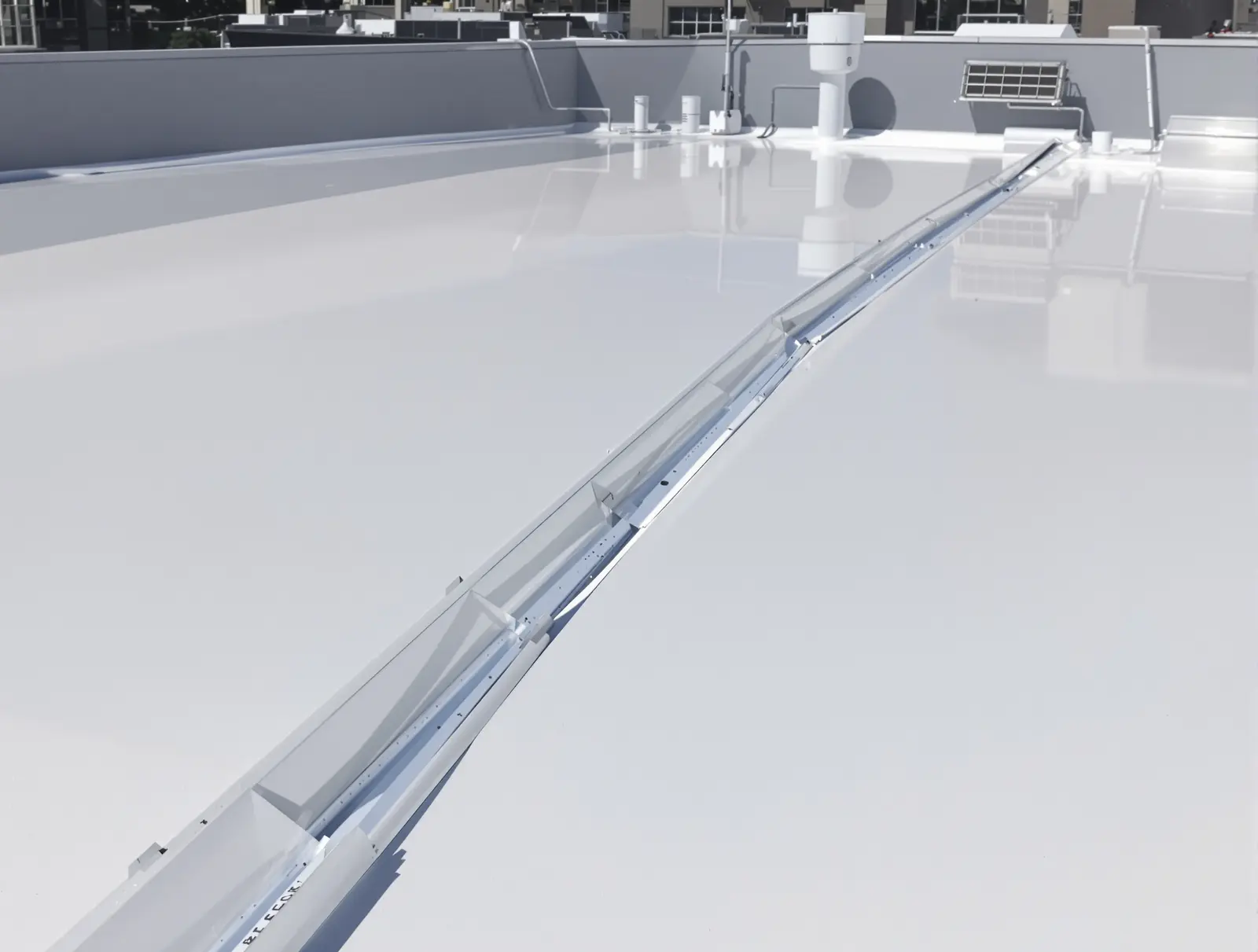
TPO is the most widely installed commercial roofing membrane in North America. It is used on warehouses, distribution centers, office buildings, retail centers, schools, and manufacturing facilities. Building owners choose TPO when they need a reliable, code-compliant roof system that delivers strong wind-uplift resistance, cool-roof energy performance, and a well-documented warranty structure — all at a lower price point than PVC or standing seam metal.
TPO is not the right choice for every building. It has specific limitations around chemical exposure, extreme foot traffic, and chronic ponding that building owners should understand before specifying this system. This guide covers what TPO does well, where it falls short, and what you need to know to evaluate proposals and make an informed decision.
How a TPO Roof System Works
A TPO roof is a layered assembly, not just a membrane. The visible white membrane is only the top layer of a system that includes the structural deck, vapor retarder (when required), rigid insulation, and the TPO membrane itself. Each layer serves a specific function, and the long-term performance of the system depends on all layers being correctly specified and installed.
Membrane Composition
TPO membrane is a factory-manufactured sheet composed of three layers. The top layer is a thermoplastic polyolefin compound that provides UV resistance and weathering performance. The center is a polyester or fiberglass reinforcement scrim that gives the membrane its tensile and tear strength. The bottom layer is another thermoplastic compound that facilitates heat welding at seams and provides compatibility with adhesives used in fully adhered installations.
- Standard roll widths: 6 feet, 8 feet, 10 feet, and 12 feet
- Roll lengths: typically 100 feet
- Available thicknesses: 45
, 60 mil, and 80 mil (see our TPO thickness selection guide for detailed comparison) - Standard color: white (tan and gray available from some manufacturers)
Heat-Welded Seams
Heat welding is what separates TPO (and PVC) from adhesive-seamed systems like EPDM. An automated hot-air welding machine travels along the membrane overlap, blowing air at 900-1100°F between the two layers. The heat softens both surfaces, and a rear roller immediately presses them together, creating a fusion bond at the molecular level. The resulting seam is homogeneous — meaning the two sheets become one continuous piece at the weld zone.
Seam integrity is the single most important quality-control factor in a TPO installation. The welding machine must maintain consistent temperature, speed, and pressure across every linear foot of seam. Weather conditions matter: cold temperatures, moisture, and wind affect weld quality. Experienced operators adjust machine settings continuously based on conditions. After welding, every seam should be probed with a blunt tool to verify the weld is complete — any point where the probe separates the layers indicates an incomplete weld that must be repaired.
Attachment Methods
TPO can be attached to the roof deck using three methods, each with different performance characteristics and costs.
: The membrane is fastened to the deck through the insulation using screws and plates at specified intervals. The most common method for commercial buildings. Lower cost than full adhesion, excellent wind-uplift ratings when fastener density matches the wind zone. : The membrane is bonded to the insulation or cover board using adhesive across its entire underside. Provides a smooth, uniform appearance with no fastener flutter. Higher cost, superior wind resistance, and reduced noise in high-wind events. Required for some warranty types and over certain deck types. - Ballasted: The membrane is loose-laid over the insulation and held in place by stone ballast (typically 10-12 lbs/sf of river-washed stone). Least common due to the weight requirement. Not suitable for buildings with structural load limitations or in hurricane-prone zones where ballast can become airborne.
Key Specifications
| Specification | 45 mil | 60 mil | 80 mil |
|---|---|---|---|
| Membrane thickness | 0.045 inches | 0.060 inches | 0.080 inches |
| Typical application | Budget projects, recover | Standard commercial | Premium, high-traffic |
| Seam method | Hot-air welded (all thicknesses) | ||
| Standard colors | White, tan, gray | ||
| Expected service life | 15-20 years | 20-25 years | 25-30 years |
| NDL warranty availability | Limited (10-15 yr max) | Up to 20-25 years | Up to 25-30 years |
| Insulation pairing | Polyisocyanurate (polyiso) most common; EPS or XPS where conditions require | ||
| Cover board | Optional | Recommended | Recommended |
| Approximate cost/sf installed | $5.50-6.50 | $6.50-8.00 | $7.50-9.00 |
Performance Characteristics
Wind Uplift Resistance
TPO delivers excellent wind-uplift performance when the attachment design matches the wind zone. Hot-air-welded seams maintain integrity under extreme wind conditions because the fusion bond is stronger than the membrane sheet. Mechanically attached systems achieve high uplift ratings by increasing fastener density in perimeter and corner zones, where wind forces are greatest. Fully adhered systems distribute wind loads across the entire membrane-to-substrate bond, providing the most uniform resistance.
Puncture Resistance
Puncture resistance varies significantly by thickness and whether a cover board is used beneath the membrane. A 60 mil membrane over a high-density
- 45 mil: adequate for low-traffic roofs with minimal foot traffic
- 60 mil: suitable for periodic maintenance traffic (quarterly HVAC service)
- 80 mil: recommended for frequent foot traffic, hail-prone areas, and rooftop-intensive operations
Chemical Resistance
TPO has moderate chemical resistance that is adequate for standard commercial environments but insufficient for certain exposures. It handles typical atmospheric pollutants, mild acids, and cleaning solutions well. However, TPO is vulnerable to petroleum-based solvents, animal fats, vegetable oils, and certain industrial chemicals. This is TPO's most significant limitation compared to PVC, which resists these substances. For a detailed side-by-side breakdown, see our PVC vs. TPO comparison.
Chemical Exposure Warning
Do not specify TPO for restaurants, food processing facilities, or buildings with kitchen exhaust on the roof. Cooking oils and animal fats in exhaust condensate chemically attack TPO, causing the membrane to soften, swell, and degrade prematurely. PVC is the recommended membrane for chemical-exposure environments.
UV and Energy Performance
TPO's white reflective surface is one of its strongest selling points, particularly on the Gulf Coast. A new TPO membrane reflects approximately 80-85% of solar radiation, meeting ENERGY STAR and Title 24 cool-roof requirements. This reflectivity can reduce cooling costs by 10-30% compared to dark-colored membranes like standard EPDM, depending on building insulation, HVAC efficiency, and climate zone. Over a 20-year service life in South Mississippi or South Alabama, those energy savings accumulate to a meaningful offset against the total roof cost.
Fire Rating
Most TPO assemblies achieve a Class A fire rating when installed with appropriate cover boards and insulation. The fire classification applies to the complete assembly — membrane, cover board, insulation, and deck — not the membrane alone. Verify the specific assembly's fire rating in the manufacturer's documentation before specifying.
Ponding Tolerance
TPO tolerates short-term water accumulation but is not designed for chronic ponding. Standing water remaining on the roof more than 48 hours after the last rainfall is considered ponding by NRCA standards. Prolonged ponding accelerates plasticizer migration, promotes biological growth, and can void manufacturer warranties. Proper drainage design using tapered insulation, adequately sized and positioned drains, and positive slope is essential for any TPO installation.
Where TPO Excels
TPO is the default specification for standard commercial buildings where chemical exposure is not a factor. When a building owner needs a reliable, energy-efficient roof system with a strong warranty at a competitive price, TPO is the most commonly recommended single-ply membrane. Its combination of heat-welded seams, cool-roof reflectivity, and moderate cost makes it the workhorse of the commercial roofing industry.
Specific applications where TPO is the strongest choice include:
- Warehouses and distribution centers: Large, open roof areas with minimal penetrations. TPO's wide roll widths (up to 12 feet) reduce seam footage, and mechanical attachment over metal deck is straightforward and cost-effective.
- Office buildings and retail spaces: Standard commercial occupancies with typical HVAC equipment. The white reflective surface delivers measurable cooling-cost reduction, and 60 mil TPO with a 20-year
meets the investment horizon of most commercial properties. - Budget-conscious projects requiring cool-roof compliance: When energy code requires a reflective surface and the budget cannot accommodate PVC pricing, TPO delivers cool-roof performance at 20-30% lower cost than PVC.
- New construction with standard mechanical equipment: TPO integrates well with typical rooftop curbs, pipe boots, and equipment supports using manufacturer-provided prefabricated accessories.
- Gulf Coast buildings in hurricane zones: Heat-welded seams maintain integrity under extreme wind, and properly designed mechanically attached or fully adhered TPO systems meet the highest FM wind-uplift ratings.
Where TPO Falls Short
Every roofing system has limitations, and TPO is no exception. Understanding where TPO underperforms is as important as understanding where it excels. Specifying TPO in the wrong application can lead to premature failure, warranty disputes, and costly re-roofing.
- Chemical exposure environments: Restaurants, food processing plants, and facilities with grease-laden exhaust on the roof should not use TPO. Animal fats and cooking oils chemically degrade the membrane. PVC is the correct choice for these applications.
- Extreme foot traffic without protection: Buildings with daily rooftop access, rooftop dining areas, or frequent maintenance activity will wear through TPO faster than multi-ply systems like modified bitumen or BUR, which offer superior puncture and traffic resistance. Walkway pads mitigate this, but high-volume traffic areas still favor thicker, multi-ply systems.
- Chronic ponding that cannot be corrected: If drainage improvements are not feasible and the roof will have persistent standing water, PVC or coal-tar BUR offer better long-term ponding tolerance. TPO warranties typically exclude or limit coverage for ponding conditions.
- Extremely long warranty requirements: While TPO warranties extend to 30 years, the membrane's real-world track record at that duration is still limited. PVC and EPDM both have longer field-proven histories. For a 30-year warranty on a critical facility, evaluate whether the warranty term exceeds the membrane's proven performance data.
TPO's track record is shorter than its competitors. TPO was introduced in the early 1990s and experienced formulation issues in its first decade. Manufacturers reformulated their TPO products in the early 2000s, and current-generation membranes perform significantly better than early versions. However, the oldest current-formulation TPO roofs are approximately 20-25 years old — meaning 30-year warranties are based partly on accelerated weathering tests rather than 30 years of field data.
Gulf Coast Considerations
The Gulf Coast climate presents specific challenges that affect TPO specification, installation, and long-term performance. Building owners in South Mississippi, South Alabama, and the Florida Panhandle should factor these regional conditions into their roofing decisions.
Wind Codes and Hurricane Exposure
Gulf Coast buildings are subject to higher wind-design requirements than inland locations. The International Building Code (IBC) and ASCE 7 establish design wind speeds that directly affect fastener density, edge-metal specifications, and membrane attachment requirements. A TPO system designed for a 115 mph wind zone will have significantly more fasteners per square foot than the same system designed for a 90 mph zone — particularly in the perimeter and corner zones where wind forces concentrate.
- Specify FM-approved assemblies rated for your location's design wind speed
- Perimeter and corner fastener densities may be 2-3x higher than field densities
- Edge metal must meet ANSI/SPRI ES-1 for the design wind speed
- Fully adhered attachment provides the most uniform wind resistance and may be required in the highest wind zones
Heat and UV Exposure
Gulf Coast roofs experience more cumulative UV radiation and heat cycling than roofs in northern climates. TPO's white reflective surface is an advantage here, reducing surface temperatures by up to 50-60°F compared to dark membranes. However, the same intense UV exposure that makes reflectivity valuable also accelerates membrane aging. Manufacturers account for this in their warranty terms, but building owners should plan for service life at the lower end of the published range when the roof receives full southern sun exposure without shade.
Humidity and Moisture
High humidity affects both installation and long-term performance. Moisture on the membrane surface during heat welding can compromise seam quality — experienced installers monitor dew point and surface conditions carefully. Long-term, Gulf Coast humidity promotes biological growth (algae, mold) on roof surfaces, which can reduce reflectivity over time. Periodic cleaning of the membrane surface helps maintain energy performance and simplifies visual inspections.
Storm Preparedness
Post-storm damage assessment is a recurring reality for Gulf Coast building owners. After any significant wind event, have the roof inspected by a qualified professional within 48-72 hours. Document the roof's condition with photos before storm season as a baseline. Ensure your insurance policy covers the full replacement cost of the roof system, not just depreciated value, and understand the difference between wind damage (typically covered) and flood damage (typically excluded from standard policies).
Cost Overview
TPO roofing costs $5.50-9.00 per square foot installed, depending on membrane thickness, attachment method, insulation requirements, and access complexity. This range covers a complete system including membrane, insulation, fasteners or adhesive, edge metal, flashings, and labor. It does not include tear-off of the existing roof (add $1.00-2.50/sf) or structural repairs if the deck is damaged. For a detailed breakdown of what drives pricing, see our TPO cost per square foot guide.
Factors That Drive Cost Within the Range
- Membrane thickness: Moving from 45 mil to 60 mil adds approximately $0.50-1.00/sf. Moving from 60 mil to 80 mil adds another $0.75-1.25/sf.
- Attachment method: Mechanical attachment is the lowest cost. Full adhesion adds $0.50-1.50/sf depending on substrate and adhesive type.
- Insulation R-value: Energy code requirements vary by climate zone and state. Gulf Coast buildings typically need R-25 to R-30 in new construction. Higher R-values require thicker insulation, which adds material cost.
- Cover board: A high-density polyiso or gypsum cover board between the insulation and membrane adds $0.75-1.25/sf but significantly improves puncture resistance and fire performance. Most consultants specify a cover board for 60 and 80 mil systems.
- Roof complexity: Penetrations (HVAC curbs, pipes, drains), unusual shapes, and multiple elevation changes increase labor cost. A simple rectangular warehouse costs less per square foot than a multi-wing office building with 30 rooftop units.
- Access and logistics: Multi-story buildings, limited staging areas, occupied buildings requiring noise/debris restrictions, and remote locations all add to project cost.
For context, a 20,000 SF warehouse with 60 mil TPO, mechanically attached, with R-25 polyiso insulation and a cover board would typically range from $130,000 to $160,000 fully installed. That same building with 80 mil TPO, fully adhered, with R-30 insulation could run $160,000-180,000. These are planning-level estimates — actual costs depend on local market conditions, time of year, and competitive bidding.
TPO Cost Estimate
$55,000 – $90,000
At 10,000 SF, a TPO roof would run approximately $5.5-$9/sf installed, depending on membrane thickness, attachment method, insulation requirements, and access complexity.
For a detailed estimate, use our full Cost Estimator →Tear-off costs are a significant variable. If the existing roof must be removed, tear-off and disposal adds $1.00-2.50/sf depending on the existing system type, number of layers, and local disposal fees. A recover (installing over the existing roof) avoids this cost but is only permissible when the existing roof has one layer, the insulation is dry, and the deck is structurally sound.
Typical Service Life
A properly installed and maintained TPO roof has an expected service life of 20-30 years. The range is wide because actual longevity depends on multiple variables that the building owner directly influences — most significantly, membrane thickness selection and ongoing maintenance.
| Thickness | With Maintenance | Without Maintenance |
|---|---|---|
| 45 mil | 15-20 years | 10-15 years |
| 60 mil | 20-25 years | 15-18 years |
| 80 mil | 25-30 years | 18-22 years |
"With maintenance" means documented semi-annual inspections and prompt repair of any damage or deficiencies. This includes clearing drains, inspecting flashings, re-sealing any lifted seam edges, patching membrane damage, removing debris, and documenting everything in writing. A maintenance program typically costs $0.03-0.06/sf per year — a fraction of replacement cost — and directly extends service life while protecting warranty coverage.
"Without maintenance" means the roof receives no professional attention until a leak or visible problem appears. Neglected roofs develop small issues that compound over time: a clogged drain leads to ponding, which accelerates membrane degradation, which leads to seam separation, which leads to leaks that saturate insulation. By the time the building owner notices a problem, years of latent damage have accumulated. The cost to address deferred maintenance always exceeds the cost of a proactive maintenance program.
Gulf Coast climate adjustment: expect service life at the lower end of each range. The combination of intense UV radiation, high heat, hurricane-force winds, and tropical moisture creates a more demanding environment than moderate northern climates. This does not mean TPO is a poor choice for the Gulf Coast — it performs well here — but building owners should plan for realistic service-life expectations and budget accordingly.
Warranty Options
TPO manufacturer warranties fall into two fundamental categories that differ dramatically in what they cover. Understanding this distinction before you sign a contract is essential — the wrong warranty assumption can leave you exposed to six-figure repair costs that you thought were covered.
Material Warranty (Standard)
A material warranty covers the cost of replacement membrane material only. It does not cover labor to remove the failed system, labor to install the new system, insulation replacement, interior damage, or business interruption. On a 30,000 SF roof where a full replacement might cost $200,000-270,000, a material-only warranty might cover $15,000-30,000 — the raw membrane material. Material warranties are included at no additional cost and are available in 10, 15, and 20-year terms.
System Warranty / No Dollar Limit (NDL)
An NDL warranty covers the full cost of repairing or replacing the roof system with no dollar limit and no depreciation over the warranty term. If the system fails due to manufacturing defects or installation errors, the manufacturer pays the complete cost to make it right. NDL warranties are available in 15, 20, 25, and 30-year terms. They cost an additional $0.15-0.50/sf as a one-time premium added to the project cost.
NDL warranty requirements are specific and non-negotiable. To qualify, the project must meet all of the following:
- Installation by a manufacturer-certified contractor at the required certification level
- Use of 100% manufacturer-branded components (membrane, adhesive, flashing, edge metal)
- Manufacturer inspection during installation at designated milestones
- Minimum membrane thickness (typically 60 mil for 20-year NDL, 80 mil for 25-30 year)
- Documented maintenance program throughout the warranty period
The NDL premium is among the best risk-management investments a building owner can make. On a $200,000 roof, a 20-year NDL warranty at $0.35/sf on 30,000 SF adds $10,500 to the project — roughly 5% of the total roof cost for 20 years of full-cost protection. A single significant warranty claim recovers that premium many times over. For detailed analysis, see our NDL warranty guide.
Choosing a Contractor for TPO Installation
The quality of a TPO installation depends more on the installing contractor than on the membrane itself. Every major TPO manufacturer produces a quality product. The difference between a 25-year roof and a 12-year roof is almost always installation quality — seam welding, fastener placement, flashing details, and workmanship at every penetration and edge condition.
Manufacturer Certification
Require a contractor who holds current, verifiable certification from the membrane manufacturer they are proposing. Manufacturer certifications are not generic — a contractor certified by Carlisle is not automatically qualified to install Johns Manville or GAF products, and vice versa. Certification levels matter: most manufacturers have tiered programs where higher-level contractors can offer longer warranty terms and NDL coverage. Verify certification directly with the manufacturer, not by relying on the contractor's verbal claim.
Experience and Track Record
Ask for a project list of TPO installations completed in the past 3-5 years, with square footage, system specifications, and references. A qualified TPO contractor should be able to provide at least 5-10 comparable projects. Specifically look for experience with your building type, roof size, and attachment method. A contractor who has installed 50 mechanically attached TPO roofs on metal-deck warehouses is well-suited for your warehouse project. A contractor whose experience is primarily residential or steep-slope work may not be.
- Verify the contractor's manufacturer certification number directly with the manufacturer
- Request proof of general liability insurance ($1M+ per occurrence) and workers' compensation coverage
- Ask for the lead foreman's name and experience — the field crew, not just the salesperson, determines installation quality
- Require a detailed written proposal that specifies membrane thickness, attachment method, fastener pattern, insulation type and R-value, edge-metal standard, and warranty type
- Obtain at least three competitive bids from certified contractors to establish a fair market price range
Be cautious of bids that are significantly below the competitive range. A bid that undercuts three other certified contractors by 20% often indicates thinner membrane, fewer fasteners, lower-grade insulation, or corner-cutting on details that will not be visible after installation but will determine the roof's long-term performance. The reading proposals guide covers what to verify in every roofing bid.
Frequently Asked Questions
How long does a TPO roof last?
A properly installed and maintained TPO roof lasts 20-30 years. The actual service life depends on membrane thickness (45, 60, or 80 mil), installation quality, maintenance frequency, and climate exposure. On the Gulf Coast, intense UV and heat exposure can reduce service life by 3-5 years compared to northern installations if maintenance is neglected. With a documented semi-annual maintenance program, Gulf Coast TPO roofs consistently reach the upper end of their expected range.
What does TPO roofing cost per square foot?
TPO roofing costs $5.50-9.00 per square foot installed, depending on membrane thickness, attachment method, insulation requirements, and access complexity. A 60 mil mechanically attached system with R-25 insulation on a 20,000 SF building typically falls in the $6.50-8.00/sf range. For a personalized estimate, use our cost estimator tool.
What is the difference between 45, 60, and 80 mil TPO?
The mil number refers to membrane thickness. 45 mil is for budget projects and recover applications with minimal foot traffic. 60 mil is the commercial standard — the most commonly specified thickness and the minimum for most 20-year NDL warranties. 80 mil is the premium option for high-traffic roofs, maximum warranty terms, and hail-prone areas. For detailed guidance, see our TPO thickness selection guide.
Is TPO better than EPDM?
TPO and EPDM serve different needs, and neither is universally superior. TPO offers heat-welded seams (stronger than adhesive-taped EPDM seams), a white reflective surface for energy savings, and better performance in Gulf Coast heat. EPDM costs less, has a longer proven track record (40+ years of field data), and performs well in moderate climates. For Gulf Coast buildings where energy efficiency matters, TPO is generally the stronger choice. For a detailed comparison, see TPO vs. EPDM.
Can TPO be installed over an existing roof?
Yes, TPO can be installed over an existing smooth-surfaced roof in a recover application. The existing roof must have no more than one layer, the insulation beneath must be dry, and the structural deck must be sound. Building codes limit total roof layers to two. A recover avoids tear-off costs ($1.00-2.50/sf savings) but may limit warranty options and does not allow inspection of the deck condition. A roofing consultant can assess whether a recover is appropriate for your specific situation.
Does TPO handle ponding water?
TPO has good short-term ponding tolerance but is not designed for chronic standing water. Water remaining on the roof more than 48 hours after the last rainfall is classified as ponding by NRCA standards and can void manufacturer warranties. If your building has chronic ponding that cannot be resolved with drainage improvements, PVC or BUR may be more appropriate. For all TPO installations, tapered insulation and properly sized drains should be specified to promote positive drainage.
What voids a TPO roof warranty?
Common warranty voidance triggers include unauthorized penetrations or modifications, failure to perform required maintenance, and undocumented repairs by non-certified contractors. Other triggers: ponding water that was not disclosed during the warranty application, physical damage from construction activities on the roof, and alterations to the drainage system. Most NDL warranties require documented semi-annual inspections. Keep every inspection report, repair receipt, and maintenance record in a dedicated file — these documents are your warranty defense. See our warranty guide for complete details.
How do TPO seams compare to PVC seams?
Both TPO and PVC seams are heat-welded using automated equipment at 900-1100°F, creating fusion bonds stronger than the membrane itself. The welding process is essentially identical between the two systems. PVC has a longer field-proven track record with heat-welded seams, dating to the 1960s in European installations, while TPO welding technology matured in the early 2000s. Both produce reliable, watertight seams when installed by trained, experienced operators using properly calibrated equipment.
Should I choose TPO or PVC for my building?
The decision between TPO and PVC comes down to chemical exposure and budget. If your building has any exposure to grease, animal fats, cooking oils, or industrial chemicals on the roof, specify PVC — it is the only single-ply membrane that resists these substances. If your building has no chemical exposure (office, warehouse, retail, school), TPO delivers comparable performance at 20-30% lower cost. For a thorough side-by-side comparison, see our TPO vs. PVC guide.
Is TPO a good choice for the Gulf Coast?
TPO is an excellent choice for most Gulf Coast commercial buildings. Its white reflective surface reduces cooling costs in a region where air conditioning is a major operating expense. Heat-welded seams maintain integrity during hurricane-force winds. And the membrane is readily available from multiple manufacturers with deep contractor networks throughout Mississippi, Alabama, and the Florida Panhandle. The key is proper specification — matching membrane thickness, attachment design, and edge-metal ratings to the local wind zone — and committing to a maintenance program that addresses the accelerated weathering that comes with Gulf Coast sun, heat, and storm exposure. Not sure if TPO is the right system for your building? Our system selector tool can help you narrow the options.