About 16 minute read
PVC Roofing: The Complete Guide for Building Owners
What Is PVC Roofing?
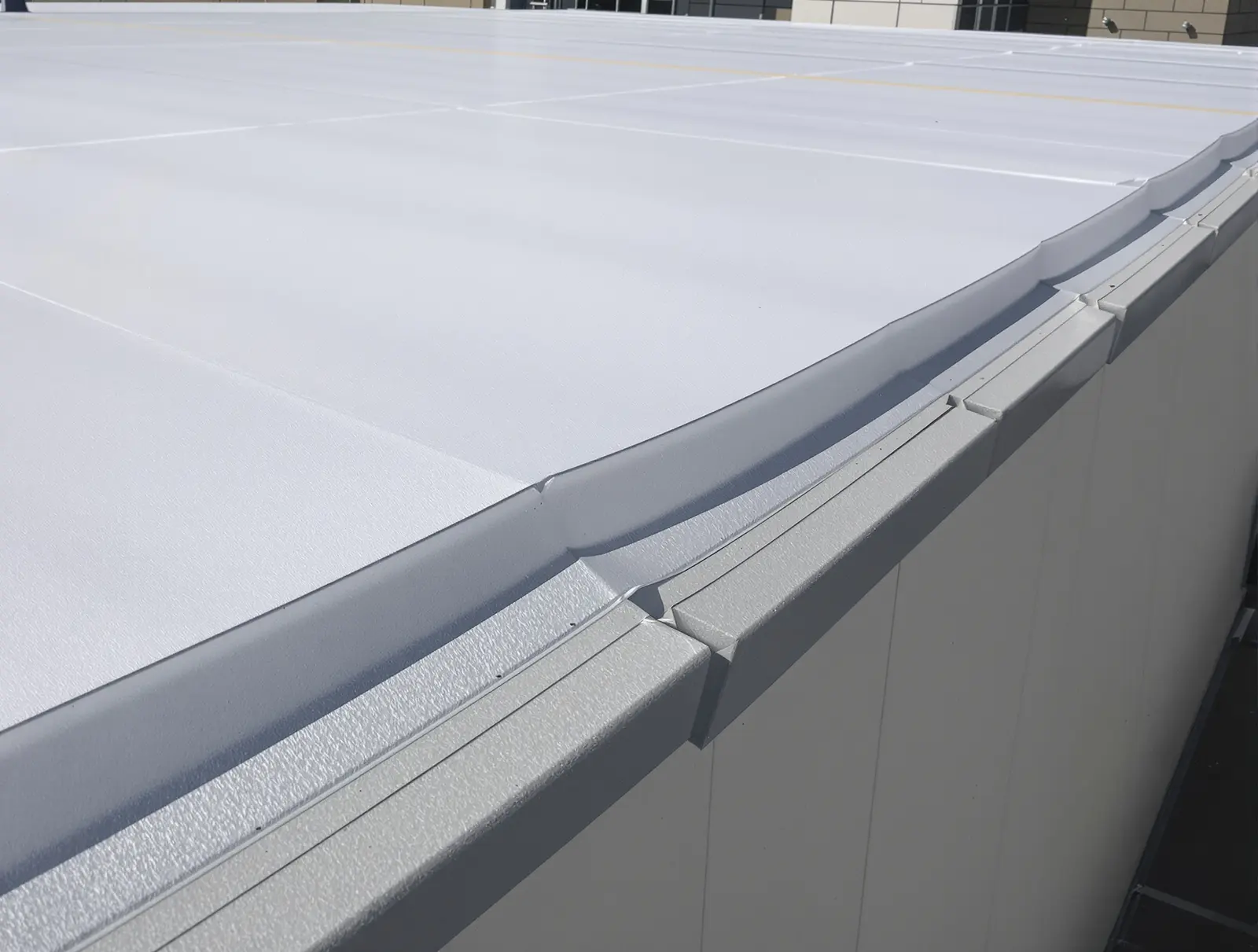
PVC has been installed on commercial roofs since the 1960s in Europe and the 1970s in the United States. That track record gives it more field-proven performance data than any other thermoplastic roofing membrane. While TPO has captured the largest share of the single-ply market since the early 2000s, PVC remains the specification of choice among roofing consultants and building owners who prioritize chemical resistance, ponding tolerance, and long-term lifecycle value over lowest first cost.
For a standard commercial building with no chemical exposure, PVC may not be the most cost-effective choice. In those applications, TPO delivers comparable waterproofing and wind performance at a lower installed cost. The decision between PVC and TPO is application-driven, not quality-driven — both are legitimate systems with specific strengths. For a direct head-to-head comparison, see our PVC vs. TPO analysis. Understanding where PVC excels and where it offers no practical advantage over less expensive alternatives is the purpose of this guide.
How PVC Roofing Works
Membrane Composition
A PVC roofing membrane is manufactured from polyvinyl chloride resin combined with plasticizers, stabilizers, UV inhibitors, and pigments. The plasticizers give the membrane flexibility — without them, PVC would be a rigid material (think PVC pipe). The quality and quantity of plasticizers used by a manufacturer directly affects how the membrane performs over its service life, particularly in cold weather and under prolonged UV exposure.
Modern PVC membranes use advanced plasticizer formulations that resist migration far better than earlier generations. Plasticizer migration — the gradual loss of flexibility as plasticizers leach out of the membrane over time — was a legitimate concern with PVC roofing manufactured before the mid-1990s. Current formulations from major manufacturers have largely addressed this issue, though it remains a factor in extreme cold climates where the membrane undergoes significant thermal cycling.
The membrane is reinforced with a polyester or fiberglass
Heat-Welded Seams
PVC seams are created by hot-air welding — the same process used for TPO — where an automated machine heats the overlapping membrane edges to approximately 900-1100 degrees Fahrenheit and presses them together under a roller. The heat fuses the two PVC layers into a single, homogeneous bond that is stronger than the membrane sheet itself. This welded seam is PVC's greatest structural advantage over adhesive-bonded systems like EPDM.
PVC heat-welded seams have the longest field-proven track record of any thermoplastic roofing weld. While TPO uses the same welding process, PVC has been heat-welded in the field since the 1970s. This gives roofing contractors, consultants, and manufacturers five decades of data on how PVC seams perform under real-world conditions — data that TPO is still accumulating. When seams do eventually fail on any single-ply system, the consequences can be significant; our seam failure guide covers what to watch for.
In addition to hot-air welding, PVC can be chemically bonded using solvent cement. This gives repair technicians an additional joining method not available with TPO, which can only be heat-welded. Solvent welding is particularly useful for small repairs, detail work around flashings, and field conditions where deploying a hot-air welder is impractical.
Attachment Methods
PVC membranes are installed using one of three attachment methods, each suited to specific building conditions and design requirements. Mechanically attached systems use fastener plates secured through the membrane into the roof deck, with the next membrane sheet overlapping and welded over the plate. Fully adhered systems bond the membrane to the substrate using adhesive or induction welding. Ballasted systems lay the membrane loose over the insulation and hold it in place with river-washed stone or concrete pavers.
On the Gulf Coast, mechanically attached and fully adhered systems are the most common PVC installations. Ballasted systems add significant dead load to the structure and can become projectiles in hurricane-force winds, making them a poor choice for coastal Mississippi, Alabama, and Florida. The choice between mechanical attachment and full adhesion depends on deck type, wind zone, and the building's structural capacity.
PVC Roofing Specifications at a Glance
Thickness Options
PVC membrane thickness directly affects durability, puncture resistance, warranty availability, and cost. Choosing the right thickness depends on your building's exposure conditions, expected foot traffic, warranty goals, and budget. Specifying too thin a membrane for your application risks premature failure; specifying too thick wastes money without meaningful performance gain.
| Thickness | Typical Application | Expected Service Life | Warranty Availability |
|---|---|---|---|
| 50 mil | Standard commercial buildings, moderate traffic, no extreme exposure | 20-25 years | Up to 20-year NDL |
| 60 mil | Higher-traffic areas, chemical exposure environments, 20+ year warranty projects | 25-30 years | Up to 25-year NDL |
| 80 mil | Maximum durability, heavy foot traffic, demanding chemical environments | 25-30+ years | Up to 30-year NDL |
PVC Performance Characteristics
Chemical Resistance
Chemical resistance is PVC's defining performance advantage and the primary reason it commands a premium over TPO. PVC is highly resistant to animal fats, vegetable oils, grease, bacterial acids, and a wide range of industrial chemicals. This resistance is inherent to the PVC polymer itself, not dependent on a surface treatment or coating that can wear away. When restaurant kitchen exhaust deposits grease and animal fats on the roof membrane, PVC maintains its integrity while TPO softens, swells, and eventually fails in those exposure zones.
Major roofing manufacturers will not warrant TPO membranes against chemical exposure from kitchen or industrial exhaust. PVC is the only single-ply membrane that carries manufacturer warranties specifically addressing chemical exposure. If your building has rooftop kitchen exhaust fans, grease hoods, or industrial process vents, PVC is not a preference — it is a specification requirement.
Wind Performance
PVC delivers excellent wind uplift resistance when properly designed for the wind zone. Heat-welded seams exceed the membrane's own sheet strength, meaning the seam will not be the point of failure under wind load. In hurricane-force conditions, the fastener pattern, deck attachment, and edge detail design determine whether the system survives — and PVC's seam integrity gives designers full confidence to push those factors to their limits without worrying about seam separation.
For Gulf Coast buildings in ASCE 7 wind zones requiring 130+ mph design speeds, PVC assemblies routinely achieve FM I-120 to FM I-180 ratings. Perimeter and corner zones require increased fastener density and enhanced edge metal, but the membrane itself is not the limiting factor. Proper engineering by a qualified roofing designer ensures the entire assembly performs as a system under extreme wind events.
Puncture Resistance
PVC's internal reinforcement scrim and slightly higher rigidity compared to TPO give it very good puncture resistance. The membrane resists point loads from foot traffic, dropped tools, and hail impact. For buildings with regular rooftop maintenance traffic — HVAC service, equipment inspections, window cleaning anchor points — PVC's puncture resistance provides a measurable durability advantage. Walkway pads at designated traffic paths further extend membrane life in high-traffic zones.
UV and Weathering Resistance
PVC formulations include UV stabilizers that protect the membrane from solar degradation over its service life. The white PVC surface reflects a significant percentage of solar radiation, reducing thermal stress on the membrane and the building below. PVC maintains its reflectivity better than TPO over time because it resists dirt accumulation and biological growth more effectively, sustaining energy savings across the membrane's full service life.
Fire Performance
PVC is inherently fire-resistant due to its chlorine content — a characteristic that distinguishes it from all other single-ply membranes. PVC membranes achieve Class A fire ratings (UL 790) in most roof assemblies without requiring additional fire-retardant additives. This inherent fire resistance makes PVC a strong choice for buildings where fire code compliance is stringent or where the roof is exposed to potential ignition sources.
Ponding Water Tolerance
PVC tolerates
Where PVC Excels
Restaurants and Food Service
Restaurants are PVC's flagship application and the building type where no other single-ply membrane is appropriate. Kitchen exhaust fans discharge animal fats, vegetable oils, and grease-laden vapor onto the roof surface. These compounds chemically attack TPO and EPDM, causing the membrane to soften, swell, and lose structural integrity within 5-10 years around exhaust zones. PVC is immune to this degradation. For any building with commercial cooking operations, PVC is the only defensible specification.
This applies to more than traditional sit-down restaurants. Fast food operations, commercial bakeries, school cafeterias, hospital kitchens, hotel food service, catering facilities, and food processing plants all generate the same chemical exposure. If the building has a Type I or Type II commercial kitchen hood, the roof should be PVC.
Industrial and Chemical Exposure
Manufacturing facilities, chemical processing plants, and industrial buildings with rooftop exhaust or process venting benefit from PVC's broad chemical resistance profile. Facilities that handle solvents, acids, petroleum products, or biological waste generate airborne compounds that settle on the roof surface. PVC provides a durable waterproofing barrier in these demanding environments where other membranes would degrade prematurely.
Buildings with Chronic Ponding
Some buildings have structural conditions that make complete ponding elimination impractical or prohibitively expensive. Inadequate deck slope, deflecting structural members, or settlement over time can create low spots where water collects after every rain event. While drainage improvements should always be evaluated, PVC provides the greatest tolerance for ponding when it cannot be fully resolved, reducing the risk of membrane degradation in standing-water zones.
Long-Term Hold Properties
Building owners who plan to hold a property for 20+ years benefit from PVC's lifecycle cost advantage. The higher first cost is amortized over a longer, more reliable service life with fewer repair interventions. PVC's solvent-weldable repair capability, superior seam longevity, and chemical durability combine to produce lower total cost of ownership on long-hold assets where the building owner — not the next buyer — pays the full maintenance and replacement costs.
Where PVC Falls Short
PVC's higher material and installation cost is its primary disadvantage. At $7.00-12.00 per square foot installed, PVC costs 25-35% more than TPO for equivalent coverage. On a 20,000 square foot roof, that premium translates to $30,000-60,000 in additional upfront cost. For buildings without chemical exposure, ponding issues, or other conditions that specifically require PVC's advantages, that premium delivers no meaningful return.
Plasticizer migration remains a consideration in extreme cold climates, though it is far less relevant on the Gulf Coast. In northern states with prolonged sub-zero temperatures, the membrane undergoes severe thermal cycling that can accelerate plasticizer loss over time. This makes the membrane less flexible and more susceptible to cracking as it ages. For Mississippi, Alabama, and Florida, where winter temperatures rarely drop below the 20s, this concern is largely academic with modern PVC formulations.
PVC and TPO are not compatible for welding. If your building has an existing TPO roof and you want to add a PVC section, the two membranes cannot be heat-welded together. Transition details require special flashing and mechanical termination that add cost and create potential failure points. This makes PVC a poor choice for partial re-roofs on buildings with existing TPO systems.
The contractor pool for PVC installation is smaller than for TPO. Because TPO dominates market share, more contractors are experienced with and certified for TPO installation. In some markets, finding a PVC-certified installer with local experience may require more due diligence. This is less of a concern in major metropolitan areas on the Gulf Coast, where multiple certified contractors serve each market.
PVC on the Gulf Coast
The Gulf Coast presents a specific combination of environmental stresses that PVC handles exceptionally well. High UV exposure, intense rainfall events, hurricane-force winds, high ambient humidity, and salt air corrosion all act on the roof membrane simultaneously. PVC's UV-stabilized formulation, heat-welded seams, and chemical inertness provide resilience against this combined assault.
Hurricane performance is a top priority for every commercial roof on the Gulf Coast, and PVC delivers. Heat-welded seams maintain full structural integrity under extreme wind uplift pressures. When properly designed with wind-zone-appropriate fastener patterns and ANSI/SPRI ES-1 edge metal, PVC assemblies consistently survive major hurricane events. Post-hurricane field surveys from storms including Katrina, Michael, and Sally have documented strong PVC performance when installation followed manufacturer specifications.
The Gulf Coast's heavy rainfall patterns make ponding tolerance a practical advantage, not a theoretical one. Mississippi, Alabama, and the Florida Panhandle receive 55-65 inches of annual rainfall, often in intense downpour events that temporarily overwhelm drainage systems. PVC's superior ponding tolerance provides a meaningful safety margin during and after these events, particularly on older buildings where drainage capacity may be marginal.
Salt air and coastal humidity create a corrosive environment that accelerates degradation of some roofing materials. PVC's chemical inertness means salt exposure does not attack the membrane itself. Fasteners, edge metal, and flashing accessories should be specified in stainless steel or coated materials in coastal applications, but the membrane requires no special modification for salt exposure.
PVC Roofing Costs
PVC roofing costs $7.00-12.00 per square foot installed, with the final price determined by membrane thickness, attachment method, insulation requirements, project complexity, and local market conditions. This range covers a complete roof system including membrane, insulation, fasteners, flashings, edge metal, and labor. It does not include tear-off of the existing roof, which adds $1.00-3.00 per square foot depending on the system being removed. For a complete breakdown, see our PVC roofing cost guide.
What Drives PVC Cost Up or Down
| Factor | Lower End ($7.00-8.50/sf) | Higher End ($10.00-12.00/sf) |
|---|---|---|
| Membrane Thickness | 50 mil standard | 60-80 mil premium |
| Attachment Method | Mechanically attached | Fully adhered |
| Insulation | Code minimum R-value | Enhanced R-value with tapered design |
| Roof Size | 20,000+ square feet | Under 5,000 square feet |
| Access | Ground-level, easy equipment access | Multi-story, crane required |
| Penetrations | Minimal rooftop equipment | Heavy HVAC, vents, curbs |
| Warranty | 15-year material warranty | 25-30-year NDL warranty |
| Market Conditions | Low demand, competitive bidding | Post-storm surge, limited labor |
The cost gap between PVC and TPO has narrowed in recent years as raw material pricing has fluctuated. In 2024-2026, the typical installed cost difference between PVC and TPO of equivalent thickness and attachment method is $1.50-3.00 per square foot. On a 15,000 square foot roof, that translates to a $22,500-45,000 premium for PVC — a significant sum that must be justified by the building's actual exposure conditions.
PVC Cost Estimate
$70,000 – $120,000
At 10,000 SF, a PVC roof would run approximately $7-$12/sf installed, depending on membrane thickness, attachment method, insulation requirements, and access complexity.
For a detailed estimate, use our full Cost Estimator →PVC Service Life: 20-30 Years
A properly installed PVC roof delivers 20-30 years of service, with the actual lifespan determined by four primary factors: membrane thickness, installation quality, climate exposure, and maintenance consistency. Buildings on the lower end of that range typically have thinner membranes, deferred maintenance, or installation deficiencies that were never corrected. Buildings on the upper end combine appropriate membrane thickness with quality installation and consistent semi-annual maintenance.
Membrane thickness sets the ceiling for how long the system can perform. A 50 mil PVC membrane starts with less material to work with and will reach end-of-life sooner than a 60 or 80 mil membrane under the same conditions. For buildings targeting 25+ year service life, specifying 60 mil minimum is a sound investment — the incremental material cost is small relative to the total project and the added years of service.
Installation quality determines whether the membrane reaches its potential lifespan or falls short. Improper weld temperatures, insufficient seam overlap, poor flashing execution, and inadequate fastener patterns create weak points that fail years before the membrane itself would have deteriorated. Using a manufacturer-certified contractor with documented PVC experience is the single most important step in ensuring the membrane reaches its design life.
Maintenance consistency protects both the roof and the warranty. PVC is a low-maintenance system, but "low" does not mean "no." Semi-annual inspections that catch clogged drains, damaged flashings, and minor membrane damage before they become major problems are the difference between a 20-year roof and a 30-year roof. Documented maintenance records also protect your warranty coverage — most NDL warranties require evidence of regular maintenance to honor a claim.
PVC Roofing Warranties
Major PVC manufacturers offer warranties ranging from 15 to 30 years, with the most significant distinction being between material-only warranties and No-Dollar-Limit (
NDL warranties for PVC are available in 15, 20, 25, and 30-year terms. Warranty length is tied to membrane thickness, attachment method, and the contractor's certification level with the manufacturer. A 20-year NDL warranty on 60 mil PVC is the most common specification for commercial buildings. The premium for NDL coverage typically adds $0.25-0.50 per square foot to the project cost — a small fraction of the total investment that provides comprehensive protection.
PVC offers one warranty advantage that no other single-ply membrane matches: enhanced chemical-exposure warranties. Some manufacturers issue specific warranty endorsements for PVC installations on restaurants and chemical-exposure buildings that explicitly cover damage from grease, oils, and chemical vapors. These endorsements are not available for TPO or EPDM at any price.
Warranty registration and maintenance documentation are non-negotiable. An unregistered warranty provides zero protection. A registered warranty without maintenance records gives the manufacturer grounds to deny a claim. Work with your contractor to ensure the warranty is registered immediately after the final inspection, and keep your semi-annual maintenance reports in a permanent file.
Choosing a PVC Roofing Contractor
Manufacturer certification is the single most important credential for a PVC roofing contractor. Each major manufacturer (Carlisle, Firestone, GAF, Johns Manville, Sika/Sarnafil, IB Roof Systems) maintains a certification program that trains contractors on their specific PVC products, welding procedures, and quality standards. Only certified contractors can offer manufacturer NDL warranties. Verify certification directly with the manufacturer — verbal claims are meaningless.
PVC-specific installation experience matters more than total roofing experience. A contractor who has installed 500 TPO roofs and 5 PVC roofs is not a PVC expert. PVC has different welding temperature windows, different solvent-weld capabilities, and different detail flashing procedures than TPO. Ask for PVC-specific project references, preferably on buildings similar to yours in size, type, and application.
Request detailed written specifications, not vague promises. A professional PVC bid should specify membrane thickness, manufacturer, attachment method, fastener pattern by zone, insulation type and R-value, cover board, edge metal standard, and warranty term. Proposals that say "install PVC roof per manufacturer specifications" without listing specific materials give the contractor maximum flexibility to use the cheapest acceptable option.
Verify insurance, licensing, and financial stability before signing a contract. Your contractor should carry general liability insurance, workers' compensation, and an umbrella policy with limits appropriate for your project size. Confirm their roofing license is current in your state. A contractor who goes out of business during your warranty term creates a coverage gap — the manufacturer warranty requires the original installer for warranty service in most cases.
Frequently Asked Questions About PVC Roofing
How long does a PVC roof last?
A properly installed PVC roof lasts 20 to 30 years depending on membrane thickness, installation quality, climate exposure, and maintenance consistency. Buildings on the Gulf Coast with regular semi-annual inspections routinely reach the upper end of that range. Thinner membranes (50 mil) trend toward 20-25 years, while 60 mil and 80 mil membranes regularly exceed 25 years when properly maintained.
Is PVC roofing worth the extra cost over TPO?
PVC is worth the premium when your building has chemical exposure — restaurants, food processing, industrial operations — or chronic ponding issues. For standard commercial buildings without chemical demands, TPO delivers comparable waterproofing, wind performance, and energy efficiency at a lower installed cost. The premium is justified by application requirements, not by PVC being inherently "better."
Can PVC be installed over an existing roof?
Yes, PVC can be installed as a recover over certain existing systems. The existing roof must be structurally sound, the insulation must be dry (confirmed by core samples and moisture survey), and local building code must permit an additional roof layer. Recover installations avoid tear-off costs and disruption, but they add weight and may not be appropriate for all buildings.
What thickness of PVC membrane should I specify?
For most commercial applications, 60 mil PVC is the standard specification. It qualifies for 20-year or longer NDL warranties and provides excellent puncture resistance for normal maintenance traffic. Buildings with heavy foot traffic, extreme chemical exposure, or 25+ year warranty goals benefit from 80 mil. The 50 mil option works for standard applications with moderate budgets and shorter warranty horizons.
Does PVC roofing handle hurricane winds?
PVC performs well in hurricane zones when properly designed with appropriate fastener density, perimeter securement, and edge metal rated to ANSI/SPRI ES-1. Heat-welded seams maintain full integrity under extreme wind uplift pressures that would separate adhesive-bonded seams. The critical factor is engineering design — the membrane is not the weak link in a properly designed PVC wind-uplift assembly.
How does PVC compare to EPDM?
PVC offers heat-welded seams, superior chemical resistance, cool-roof energy savings, and better ponding tolerance. EPDM costs less upfront and has a long track record, but relies on adhesive seams that are more vulnerable to failure over time. For Gulf Coast buildings, PVC's welded seams and reflective white surface provide meaningful advantages in both performance and energy efficiency.
What maintenance does a PVC roof require?
PVC roofs need semi-annual inspections focused on drain clearance, flashing integrity, seam condition, and membrane surface evaluation. Clear debris from drains and scuppers after every major storm. Repair any punctures or mechanical damage promptly. Keep a written log of every inspection and repair — this documentation protects your warranty and provides valuable data for long-term planning.
Can PVC roofing handle ponding water?
PVC tolerates ponding water better than any other single-ply membrane. Its chemical inertness and resistance to biological growth mean standing water causes less degradation than it would on TPO or EPDM. However, proper drainage design should always be the first priority. Chronic ponding adds structural load and creates maintenance challenges regardless of membrane type.
Is PVC roofing recyclable?
Yes, PVC is a thermoplastic and can be recycled at end of life. Several manufacturers operate membrane recycling programs that reclaim old PVC roofing for use in new products, reducing landfill waste. This is a meaningful sustainability advantage over thermoset membranes like EPDM, which cannot be melted down and reformed.
What warranties are available for PVC roofing?
Major manufacturers offer PVC warranties ranging from 15 to 30 years. No-Dollar-Limit (NDL) warranties — which cover the full cost of repair or replacement without depreciation — are available in 15, 20, 25, and 30-year terms through certified contractors. Some manufacturers offer enhanced chemical-exposure warranties exclusively for PVC, covering damage from grease, oil, and chemical vapors that are not warrantable under TPO or EPDM.
If you are still weighing your options, our interactive system selector helps you match your building's conditions to the right membrane in minutes.
Ready to evaluate PVC for your building? A professional roof survey identifies the right system based on your specific conditions.
Request a Commercial Roof Survey